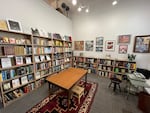
The independent bookstore Kid Hermes the Trickster opened on Feb. 27, 2026 in downtown Portland . It contains roughly 1,700 books that come mainly from the personal library of owner Doug Lowell. An interior view of the store is shown in this provided photo taken in March 2026. The bookstore also features a gallery space for rotating art exhibits like collages made by Portland artist Kevin Cascell, which are on display until April 30, 2026.
Courtesy Doug Lowell
Doug Lowell spent nearly 40 years in the world of advertising, from co-owning an ad agency to teaching the subject at Portland State University. But it was only in retirement that he was able to achieve his dream job of opening his own bookstore.
As a third-generation Portlander, the business also allows him to play a part in the revitalization of Portland’s downtown, which he recalls once being the envy of other cities.
Lowell began welcoming customers to the store, Kid Hermes the Trickster, about a month ago.
Oregon ArtsWatch recently profiled Lowell and his new venture. The 830-square-foot space in downtown Portland is packed with roughly 1,700 books that come mostly from Lowell’s personal library.
In addition to literary classics from Jane Austen and Franz Kafka, visitors might find rare first editions and signed copies of titles spanning photography, science fiction or even a 16-volume collection of the Oxford English Dictionary.
There’s also a gallery inside the store where Lowell hosts art exhibitions featuring local and international artists.
Lowell joins us to share his vision and hopes for Kid Hermes the Trickster.
Note: The following transcript was transcribed digitally and validated for accuracy, readability and formatting by an OPB volunteer.
Geoff Norcross: From the Gert Boyle Studio at OPB, this is Think Out Loud. I’m Geoff Norcross. A few years ago, Doug Lowell looked around his house and realized he had too many books. He also knew all those books would be a problem for his kids after he passed away. At the same time, he had been hearing that young readers might really be interested in his personal collection and they just love independent bookstores. So with all that in mind, he opened a bookstore in downtown Portland last month. It’s called Kid Hermes the Trickster. Oregon ArtsWatch first reported on the store earlier this month.
Doug Lowell was able to pull himself away from the store for a little while and come down to our Portland studios. Doug, welcome to Think Out Loud. It’s great to have you.
Doug Lowell: Oh, Geoff, I can’t believe it. It’s so fun to be here.
Norcross: When did you first get this idea?
Lowell: You know, retirement’s wonderful. But at the same time, I found myself missing a certain kind of mission and purpose and engagement with the public. And so I think it was probably about eight months ago, I was looking around saying, “I wonder if I should open a photography gallery,” because Portland needs another photo exhibition space really badly, actually. It really does. We’ve lost multiple ones in the last 10 years. But then I realized there’s no money in that because there aren’t that many photo collectors.
So then I freelanced – well, not freelanced – I part-time worked for my friend May Barruel at Nationale, a gallery out in Southeast Burnside and 22nd. And I worked Sundays for her and she has this perfect combination of a bookstore and an art gallery, and I realized, aha! After a few months of working there, this is a great idea.
Mine’s different though from May’s. May’s are all new books. Mine are almost all used books, for the majority of them. And so I decided, you know what? I know the book trade. I worked at it in my twenties. What the heck? It’s a way to get rid of the books. It’s a way to do something purposeful. It’s a way to make some extra money so that my wife and I can take a vacation sometime. So I did it.
Norcross: When you say you worked in the book trade, what do you mean?
Lowell: Well, I used to work in and then manage eventually, used and rare bookstores in San Francisco, all through my twenties. I was in graduate school at the New College of California Poetics graduate program in ’82. And one day I told my wife, you know what, I’m gonna go out and I’m gonna get a job in a bookstore. And she said, “you can’t just do that!” I said, “I don’t know. I think maybe I can.” [laughter]
So, I had my resume all printed out. I went to bookstore, bookstore, bookstore, bookstore, bookstore. And finally one of the last ones I went to, I was browsing through it. It was a really nice little used bookstore in the Tenderloin, which is a really tough part of town. But it’s where all the bookstores were in San Francisco, or a lot of them. After I browsed through the whole shop, I came up and I said to the gentleman behind the counter, “do you ever hire part-time work?” He said, “Well, I noticed that you were straightening the books as you browsed. [laughter] And yes, I am looking for someone.” So I got a job.
Norcross: When you took that experience and thought you could fold it into a bookstore of your own, and you told your friends and your family about that idea, what kind of reaction did you get?
Lowell: Friends were all behind it. Family? My children were worried that I was gonna return to the stressed out person who was an advertising dad all through their growing up. And I get it. I totally get it. But what they didn’t understand was that bookselling was the best job I ever had in my life.
Norcross: Why?
Lowell: Because it was not stressful, because it was good for the world. Because you didn’t take it home with you, you didn’t have to work 80 hours a week at it like you do in advertising. You didn’t have the life and death of your success dictated by a client decision to either accept or reject a campaign idea. And I love books, I love literature, I love art and I love photography. So it’s just perfect for me.
Norcross: Let’s hear a little bit more about your store. First, let’s start with the title: Kid Hermes the Trickster. What’s that about?
Lowell: Everyone asks that. And I’ve learned through years of brand work, it’s always good to have a brand name that makes people ask questions, right? Because then you’re immediately in a conversation with someone. But Hermes is my favorite Greek god, first of all. If you read “The Homeric Hymn to Hermes,” it tells this great story about Hermes starting at age day-one. When he was 1 day old, he crawled out of his crib and stole his brother Apollo’s cattle. He drove the beloved cattle backwards, so they couldn’t be tracked, to a distant meadow. Then he crawled back into bed.
His brother comes storming in and says, “did you take my cattle?” And he says, “I’m just a baby. What’s a cow?” [laughter] He had to fess up. His father Zeus, the common father of the two, made them come to terms. To make up for it, Hermes, who had also on day one, invented the lyre, the first musical instrument. He gave the lyre to Apollo as an apology gift. And it made Apollo the god of music from then on.
Anyway, I just love Hermes and he always treated mortals really well. He didn’t play tricks on us, just on the gods.
Norcross: That’s kind [laughs]. So, a big part of your collection, and you can tell me how big, is actually your private collection from home. Is that right?
Lowell: Yes, exactly. I’d say probably 50% of the books in the store are from our own personal collection, and I’ve supplemented.
Norcross: What kind of books are they?
Lowell: I have about 300 photography books that I’ve built a working library of, over the last 27 years because I’m a photographer and that’s how I learned, as well as going to graduate school for photography. But photo books are also my great love. And then there are art books. All the art books in there were from my own personal collection. So every time one sells, I say, “wow, you’ve got really good taste in art,” [laughs] which, of course, is because it was my book and I think so.
But then with fiction and science fiction, I really wanted to carry a lot of those that were relevant especially to the younger generation, Gen Z, who have single-handedly really brought back the indie bookstore, according to all the studies. I’ve read and have bookmarked probably 30 articles, just on Gen Z and books, on my computer. I wanted to carry the kind of books they were interested in, both as readers and as collectors. Because right now, for Gen Z, the physical book really matters. They love physical books, they love analog books, they love buying from brick and mortar bookstores.
I thought, “this is perfect, this is great!” Because my idea was a careful selection of books, any of which I could recommend, or my wife, who reads a novel every two weeks. We could recommend them. But also, as a great, wonderful bookseller in New York has said, “You also have to be aware of the zeitgeist. What’s going on? What do people want?” So it’s been a great challenge to find those books that I both can believe in and know. Like books by Philip K. Dick, for instance, or Ursula K. Le Guin, as well as authors I don’t really know like Liu Cixin who wrote “The Three-Body Problem,” which is a TV show and such. And bring together a collection that, when people walk in, they’re gonna find something unusual, they’re gonna find something nice. It’s probably gonna be a reading copy, but in hardcover. Or it’s gonna be a first edition, collectible. Or it’s gonna be a signed copy even, or maybe an illustrated version of a favorite book or of a new book.
Norcross: You haven’t been open that long, but are you seeing Gen Z come into your door?
Lowell: Yeah, definitely, but I’m seeing all the generations.
Norcross: OK, but you focused on Gen Z and their love for books. Why do you think that is? Why do you think they are so endeared to this analog world, digital natives they be?
Lowell: I think about this a lot because I used to teach at Portland State University and I used to tell my students, “you know what, there’s a fortune to be made in becoming a therapist that helps people separate from their phones.” And they just laughed at me. But I think that’s a huge part of it. Gen Z is the first generation born digital natives. In a sense that was fate handing them something. And what every generation has always done, it strikes me, is look around and say, but what else is there that we don’t have that we might want from other generations? In the ‘60s, we did that with Victoriana. Suddenly everyone was wearing leather jackets with, what are those called …
Norcross: The fringe?
Lowell: Yeah, fringe. Thank you. Fringe leather jackets like from the frontier days and moccasins. [laughs]
Well, I think Gen Z is looking around going, you know what? Books, books, books. They’re an escape from the screen. What they’re feeling is really an entrapment – which it is. And also at the same time, they’re saying, there’s something about how I feel when I touch a book, when I hold it, when I look at it. They’re saying we need to own this for ourselves, even though we are the digital natives.
Norcross: Doug, you said that like 50% of your inventory was your personal collection. When did you have the idea that this is not something that my family is going to want, this is something I should sell?
Lowell: Well, OK, so I went through my mother and stepfather’s deaths, and I’m the sibling in town. So my wife and I got to be point people on that. The process of going through moving them out of their house at the coast, then moving them out of their house in Portland, then moving them out of their bigger apartment to assisted living, then moving, etc. etc. My kids witnessed that. They didn’t want any part of helping us, except they did help some. But they were like, “You know what, this is really intense for us. I don’t really want to get sucked into that.” And I realized they’re not gonna want to get sucked into it when we die either.
So to be responsible is to pay attention. A lot of people assume, “oh, you’re gonna love these books, you’re gonna want them.” And no, the fact is, not really as much. Like the china and the silver sets that younger generations don’t really want necessarily. And the older generations are like, “What? How could you not want this?” So I felt, you know what? It’s our responsibility to deal with this.
Norcross: Are you putting it all in the store or are you holding something back?
Lowell: I’m holding some things back.
Norcross: Why are you holding them back? What are they?
Lowell: There’s some photo books by people who are personal friends, who signed them to me. And there are just a few I can’t let go of, even though I’ve been really good at letting go. There’re books by people I knew personally, deeply. An artist named Jess, I’m keeping all the little things he gave us and his books. There are a few novels that I still want to read that I’m keeping. I’ll always have a copy of Kafka’s short stories, for instance. But I’ve got that in the store too. It’s an interesting process, Geoff, to try and figure out, what do I save and why?
Norcross: Are you open to the possibility you might be wrong? Somebody might buy a title in your book and it will hurt for you to not have it anymore in your life?
Lowell: I took that as a possibility. However, so far after a month of selling quite a few books, I haven’t felt it once. I’m lucky.
Norcross: Can you describe the space for me? What’s it like there?
Lowell: All right, it’s 830 square feet in an old retail storefront, at the base of a building built in 1925, the old Medical Arts Building. It has two floors. It has a small ground floor and then it has a larger mezzanine. And the ceiling at the ground floor level is about 20 feet high. So I have room for photography and art exhibitions on two big walls, while the rest of the floor, the wall perimeter, is books. Then upstairs I have some comfortable chairs and a lamp from my grandparents. I have a table and two chairs for people to sit down with a stack of books to look at. There’s an art installation by Leslie Hickey up there of a telephone that you can dial and you can get your horoscope or you can leave a message for Leslie.
Norcross: You were talking about the beauty of books with our phones dinging at us all the time. So how perfect, right?
Lowell: You know, it’s interesting, Geoff. A gentleman who’s told me he’s 65, he came in just a couple of days ago and he said, “Doug, you know what? I’m reading. I tell my friends, I’m reclaiming my attention span.” And they say, “how are you doing that?” I said, “books.” And they say, “do you do that because you like the touch, the feel and the smell?” I said, “no, because I can’t just press the center of the page and change it to something.” I think we all have a chance to regain our attention spans through books.
Norcross: Hearing you describe the space, it feels more like a community space and a place to hang more than it does a bookstore, a place of commerce, you know what I mean?
Lowell: I hope it is. I really hope it is. I hope it’s a place, especially with the photo books, for the young photographers to be able to look at. A lot of these books, you’ll really have a hard time finding on a shelf anywhere.
Norcross: Why did you want to open a brick and mortar location instead of going online?
Lowell: Oh my heart … Because online is empty transactions. Online is just a meaningless prompt from your email that you’ve got to mail a book now. There’s no give and take. There’s no social engagement. And I love the social engagement. Part of the reason you love books is because you also love talking about books, in my case at least. Talking with people about the books, making recommendations, and seeing the people who take a book and knowing where it’s going, that matters. Social engagement matters. We’re learning that a lot.
Norcross: Your store is in downtown Portland, which quite famously has been through some stuff. It’s seen some rough patches. Why did you want to locate it there?
Lowell: I’m a believer in downtown. When I was growing up in Portland, downtown was the coolest place. It’s where you went, if you could go, you went downtown, unless your mom made you go out to the neighborhoods to see the movie at a cheaper movie house. Downtown was also lively and vibrant up until just really like the pandemic and such.
Cities used to bring entourages of leadership to visit Portland to see how Portland did what it did to keep its downtown vibrant. That was a big part of Mayor Neil Goldschmidt’s vision for the city when he pulled all the brain trust together, to make downtown amazing. And I think it can be, that can be done again.
Norcross: Can I ask how old you are?
Lowell: Yeah, I’m 70.
Norcross: Yeah? [laughs]
Lowell: I see this one coming, Geoff. [laughs]
Norcross: Yeah, you got the energy for this?
Lowell: Yeah, I asked myself that question multiple times. The crazy thing is, I really do, and I actually get more energy as I’m doing this.
Norcross: What were the other options for your retirement besides owning a store?
Lowell: I’m a photographer and I publish photography books of my own. I self-publish and I like to have opportunity to cook for friends. But I really missed a mission. I really missed something I could be successful at. Because photography is very hard to develop an audience. It’s almost impossible to get a gallery nowadays and I missed the engagement. And I do have the energy. It’s crazy. I guess I would say to people I didn’t know if I would. But once I started to do it answered that question for me.
Norcross: Yeah, how do you envision the future of Kid Hermes the Trickster?
Lowell: I figure I’d probably run it for the next 10 years, and all the while, I’m trying to groom its replacement owner.
Norcross: And who might that be? Maybe one of your kids? You think they might want to step up?
Lowell: No, definitely not.
Norcross: You’ve talked about it with them?
Lowell: They’re capable. They would be amazing booksellers, but they have their other things. My son’s in New York. And one of the questions he always asks women when he was dating was, he had two questions … One, “do you want to have kids?” Two, “do you want to stay in New York?” [laughs] My daughter owns her own preschool, so she’s an entrepreneur too. And so, no, it’ll be someone else. I don’t know who yet.
Norcross: What’s been the most surprising thing about this whole process?
Lowell: The reaction. How many people have come out of the woodwork. How many people have loved the space, this little space. How many people have said, “this is what Portland needs.” That’s really surprising.
Norcross: Why did that surprise you?
Lowell: Because you always hope, but you don’t know. I did my best research and I’m a good researcher. I knew this, on paper, looked right, but you never know if it’s gonna work. The fact that I’m already covering my overhead in my first month … I know business world and that’s insane. That’s really hard to pull off. So, I’m just really, really happy and humbled that it’s working.
Norcross: This has been great. Doug Lowell, it’s been a pleasure to talk to you. Thank you so much and best of luck with the store.
Lowell: Geoff, thank you. It’s so great to meet the voice. [laughter]
Norcross: Doug Lowell is the owner of Kid Hermes the Trickster Bookstore in downtown Portland.
“Think Out Loud®” broadcasts live at noon every day and rebroadcasts at 8 p.m.
If you’d like to comment on any of the topics in this show or suggest a topic of your own, please get in touch with us on Facebook, send an email to thinkoutloud@opb.org, or you can leave a voicemail for us at 503-293-1983.